
Automated solutions to optimise logistics flows
JYGA supports logistics, supply-chain and e-commerce operators with end-of-line automation projects. Our robotic solutions automate repetitive operations such as case packing, case unpacking, palletising, depalletising and handling parcels, crates, cases and packaged products.
As volumes increase, SKU counts grow and lead times become shorter, logistics robotics can improve consistency, productivity and working conditions. JYGA designs equipment around existing processes, space constraints and throughput targets, from standalone machines through to complete integrated solutions.
Our teams support project studies, selection of gripping technologies, robotic-cell layout and integration of peripheral equipment. The objective is to make logistics operations more reliable, reduce manual handling and improve product flow at the end of the line or within the warehouse.
They trust us


What our customers say
Logistics
Palletizer for Collapsible Plastic Totes
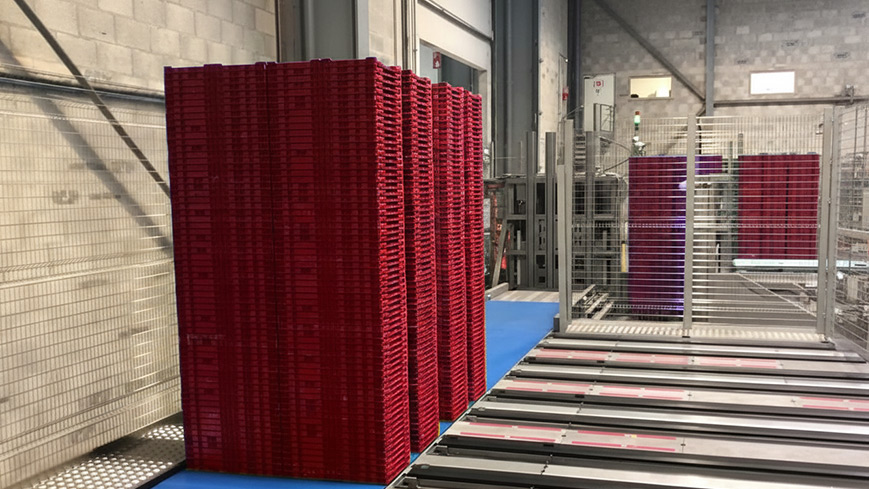
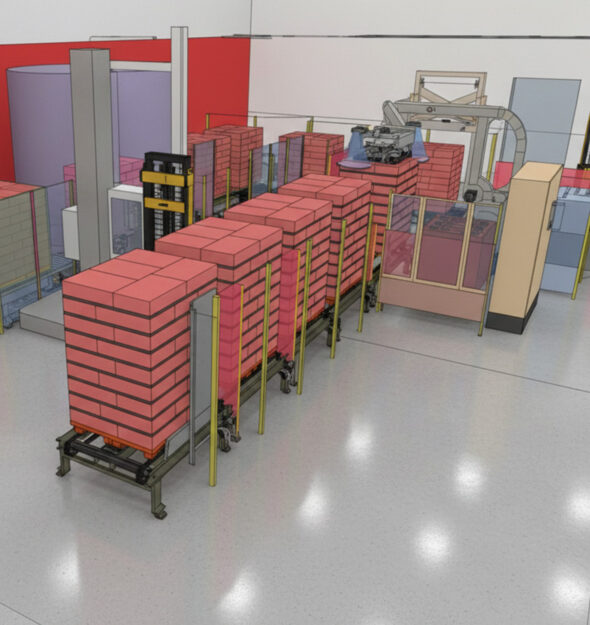
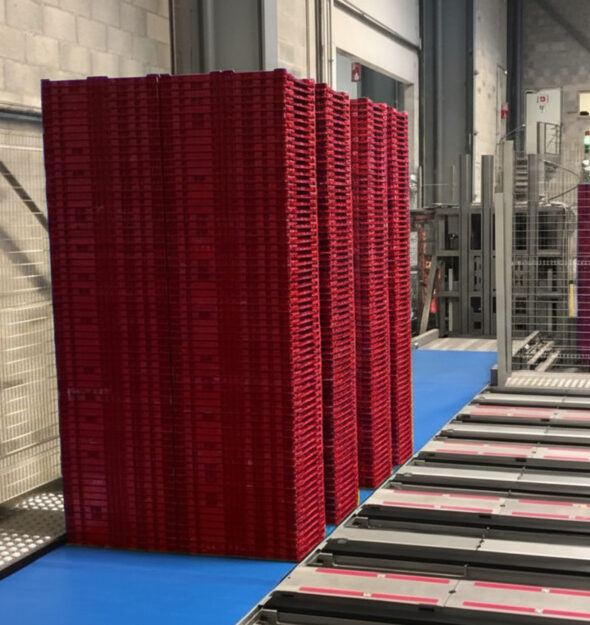
For a logistics company handling collapsible plastic totes, JYGA installed a complete line with a dedicated palletizer. Stacks of folded totes are distributed across 14 sorting lanes and then conveyed to collector conveyors. Once a complete stack is ready, it is sent to an accumulation buffer that feeds palletizing for multiple product references. When four stacks of the same reference are ready, they are placed on an automatically supplied empty pallet. A height check verifies the number of totes per stack. Full pallets are then strapped by three independent strapping machines, labelled and accumulated for forklift collection.
Our latest case studies in logistics
Products we handle
No related content found.
Our machine solutions
Logistics: automated packaging and logistics robotics
With the growth of e-commerce and the need to optimise warehouse processes and systems, logistics automation is expanding rapidly. Robotics can automate selected tasks to simplify operations and improve efficiency. In warehouses and distribution centres, logistics robots can perform palletising, sorting and parcel-handling operations. Their speed and repeatability can improve throughput while helping optimise operating costs.
JYGA brings its experience to logistics automation, automated handling and robotic systems, providing turnkey solutions adapted to each project.
What does the logistics sector involve?
Logistics covers all activities associated with the supply chain, from production through to final product distribution. It includes transport, storage systems, handling, packaging, order processing and order tracking. Effective logistics is therefore a key part of the global economy, enabling warehouses and distribution operations to manage resources efficiently and meet customer expectations for quality and speed.
Challenges in logistics
The impact of new technologies
Technological advances are having a major impact on logistics. Warehouses need to adapt to developments such as artificial intelligence, robotics, automation and the Internet of Things to optimise supply-chain operations. These technologies can improve performance, speed and process reliability, while also changing the skills and roles required within logistics. Working with a specialist automation partner can help manufacturers and logistics operators manage this technological transition with greater confidence.
The environmental challenge
In response to environmental concerns and increasing public awareness, transport and logistics operators are under growing pressure to adopt more sustainable and responsible practices.
One area of focus is reducing unused space within packaging, pallets and transport vehicles. Advances in automated order preparation increasingly rely on robots combining agility with software intelligence. Machine vision and pattern-recognition technologies can help optimise parcel arrangement and pallet layouts, supporting more efficient and responsible logistics automation.
The efficiency of a depalletising or palletising robot can be improved significantly when accurate pallet-pattern information is available in advance.
JYGA specialises in automated case handling and robotic palletising. Combining more than 30 years of experience with in-house engineering capabilities, our teams develop complete solutions including product-flow management and communication between equipment.
Integrating robotic arms into logistics operations
Types of robotic arms
Robotic arms generally fall into two main categories. Industrial robots are primarily used to automate repetitive or potentially hazardous operations and provide high rigidity and movement speed. Collaborative robots are designed to work in close proximity to people, including within shared work areas. They prioritise safety and flexibility, typically operating at lower speeds where the application requires collaborative operation.
Logistics robotics can take many forms. Examples of applications developed by JYGA include:
- Picking robots: designed for automated picking operations, these robots provide high positioning accuracy and can handle objects of different sizes and shapes, helping optimise order-preparation processes.
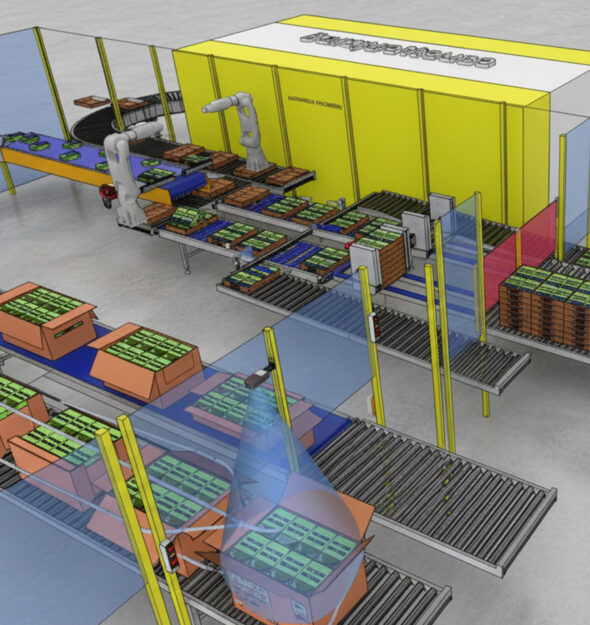
- Case packing and packaging: robots can also automate the packing of goods into protective secondary packaging.
- Robotic palletising: industrial robots fitted with an end-of-arm tool suited to the parcel type can handle heavy loads, work at height and maintain high throughput. The same robotic technologies can also be used for depalletising operations.
- Collaborative robots: cobots are designed to work in close cooperation with operators, helping improve efficiency and reduce handling-related risks. They can assist with handling, packaging and palletising tasks.
- Storage: logistics automation can also extend to storage systems, using automated equipment to optimise available space and improve real-time tracking of goods.
Benefits of logistics robotics
Logistics operations face a range of challenges. Companies seek to reduce costs while improving productivity and maintaining customer satisfaction. Robotics can support these objectives and offers several potential benefits:
- Improved productivity: rapid, repeatable operation and the ability to run for extended periods can increase overall throughput.
- Fewer errors: automating selected operations can reduce manual errors and improve consistency in products and services.
- Better use of space: automated systems can help make more efficient use of warehouses and distribution centres, including constrained storage areas.
- Improved parcel tracking: connected technologies can support real-time visibility of inventory and parcel flows, helping inventory management and replenishment planning.
- Flexibility and adaptability: robotic systems can be reconfigured as requirements and environments change. This modularity is particularly valuable in a logistics sector where volumes, formats and operational needs evolve quickly.
The role of people alongside robotics
Although robotics offers many benefits, it does not remove the need for human expertise. Managing unexpected situations, solving complex problems and communicating with customers remain important responsibilities that depend on people.
Human-machine collaboration
A major challenge is finding the right balance between automation and human involvement. Logistics robotics should be designed as a tool that supports employees rather than simply replacing tasks. JYGA can assist with reorganising workflows and provide appropriate training so that teams can make effective use of new technologies.
Improving quality of working life
Robotics can also improve working conditions by reducing physically demanding tasks and limiting certain accident risks. Employees can focus on higher-value activities while benefiting from a safer and more comfortable working environment. For businesses seeking to optimise processes and remain competitive, logistics automation can therefore provide significant opportunities, provided that implementation takes account of both operational requirements and the role of people.