
JYGA automatic palletisers and palletising robots
Our automatic palletising systems, based on articulated-arm robots, manage pallet positioning as well as product pick-and-place operations. JYGA offers several configurations to suit your production lines.
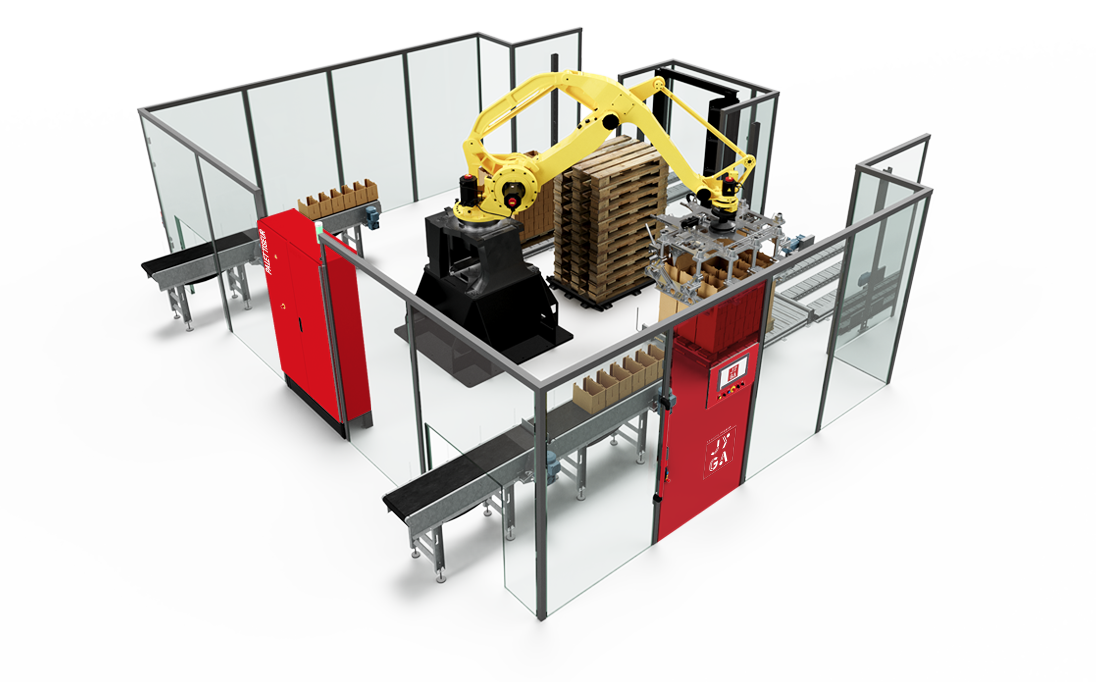
Industrial palletisers
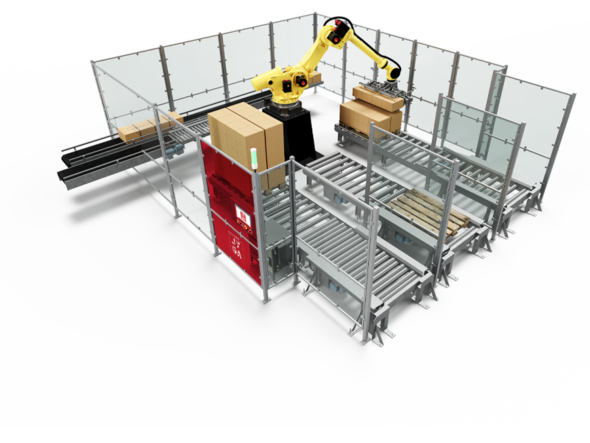
The JYGA robotic palletiser combines an articulated industrial robot, a gripper selected for the product and a fully guarded cell. It palletises up to 35 cases/min (JYGA 2026 brochure). It is available in a single-line version, for one production line, and in a multi-line version, for several lines. The PAL’IT ONE compact palletiser completes the range. A comparison of these machines and the PAL’IT AIR cobot, with figures, is given in the section on choosing a palletiser.
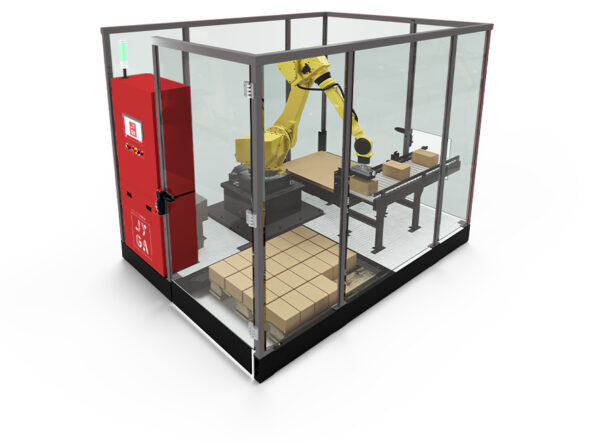
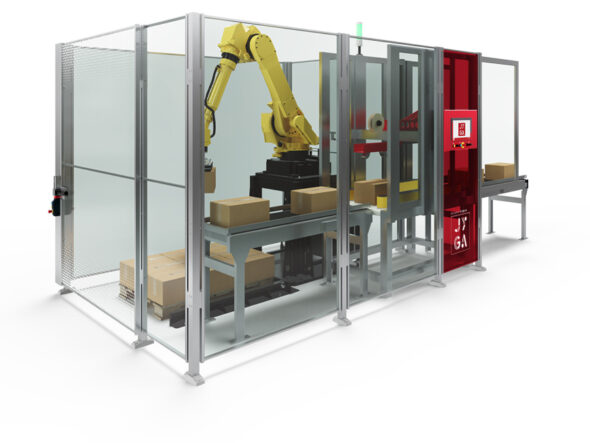
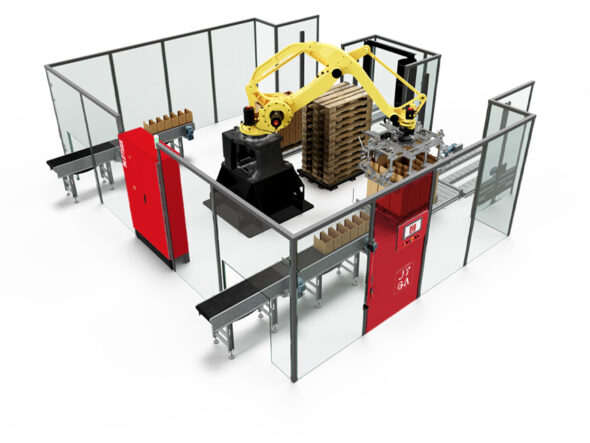
Cobot palletisers
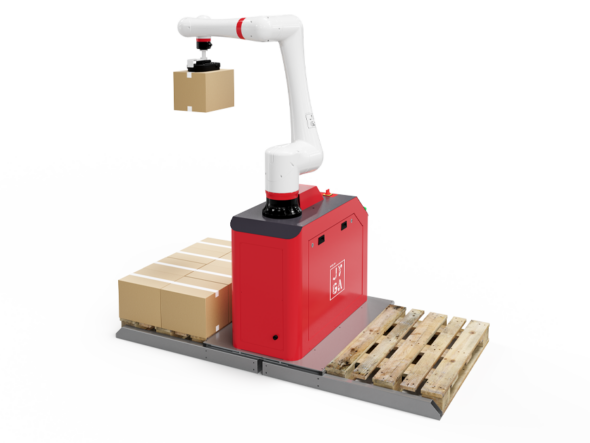
The PAL’IT AIR is a palletising cobot designed to work without safety fencing, alongside operators. JYGA intends it for moderate throughputs and for end-of-line areas where there is not enough space for a guarded cell. Its full specifications are given on the PAL’IT AIR palletising cobot page.
Depalletisers
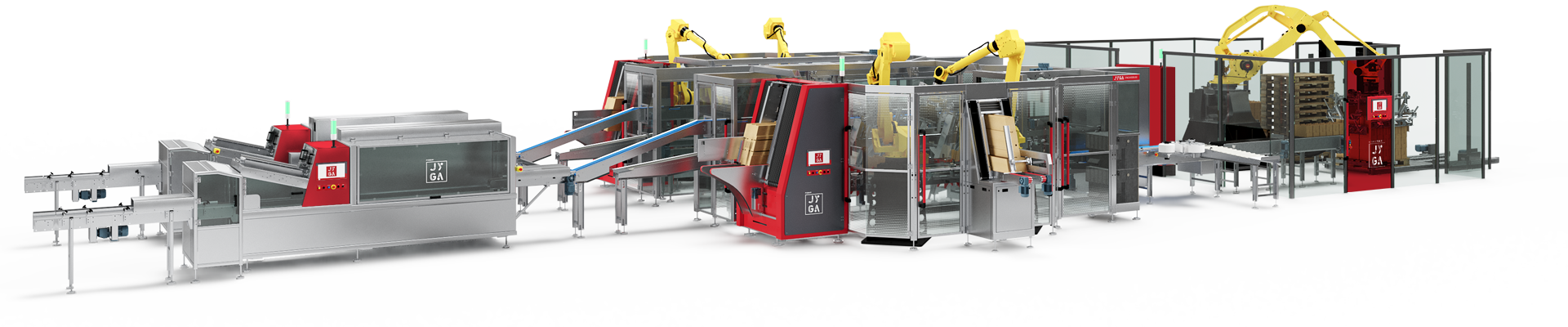
Depalletisers perform depalletising and, where needed, case palletising functions, in order to rebuild pallets on new pallet formats as well as mixed pallets with different carton formats.
Looking to complete
your end of line?
Trusted by






















JYGA, your partner foryour packaging projects
Needmore information?
Our sales teamis here to help!
Which palletiser should you choose for your cartons, cases or bags?
Five criteria guide the choice of a palletiser: the throughput per line, the weight and format of the packages, the number of lines, the space available and whether operators work nearby.
Palletisers on the market fall into three families: layer, Cartesian and robotic. A layer palletiser forms each layer on a table before placing it. A Cartesian palletiser moves its pick-up head along a gantry. A robotic palletiser uses an articulated robot or a cobot. JYGA designs robotic and cobotic machines built around an articulated robot or a cobot, whose gripper can also pick up an entire layer.
The table compares the JYGA range against these criteria. The note “project-dependent” indicates a value that depends on the product, the load and the layout.
| Machine | Throughput | Case weight | Lines served | Footprint | Key feature |
|---|---|---|---|---|---|
| Robotic palletiser, single-line or multi-line | up to 35 cases/min | project-dependent | one line, or up to 4 in the multi-line version | 3,500 × 3,500 × 2,200 mm (for one line) | format changeover in under 5 min; industrial robot in a guarded cell |
| PAL'IT ONE compact palletiser | up to 16 cases/min | up to 25 kg | one or two lines | 2,310 × 3,545 mm (single version) | can be moved without reconfiguration |
| PAL'IT AIR palletising cobot | 6 to 18 cases/min | 25 kg maximum | up to two lines simultaneously | 800 × 1,740 × 1,372 mm (for one palletising station) | fenceless cobot, operators nearby |
Palletising robot or cobot: how to decide?
The thresholds of the JYGA range determine which configuration fits:
- Up to 18 cases/min and 20 kg per case*, where operators work around the station, the PAL’IT AIR cobot palletises without safety fencing, on one or two lines.
- For cases up to 25 kg, at no more than 16 cases/min, the PAL’IT ONE compact palletiser serves one or two lines. It can be moved without reconfiguration when the station is relocated as the plant is reorganised.
- Beyond these two ranges, the choice is a robotic palletiser in a guarded cell, up to 35 cases/min.
- When several lines, up to four, converge on the same palletising area, the automatic multi-line palletiser is a space-saving solution.
*Maximum throughput and case weight of the Pal’it Air, to be confirmed for each project
Which machine for palletising cartons?
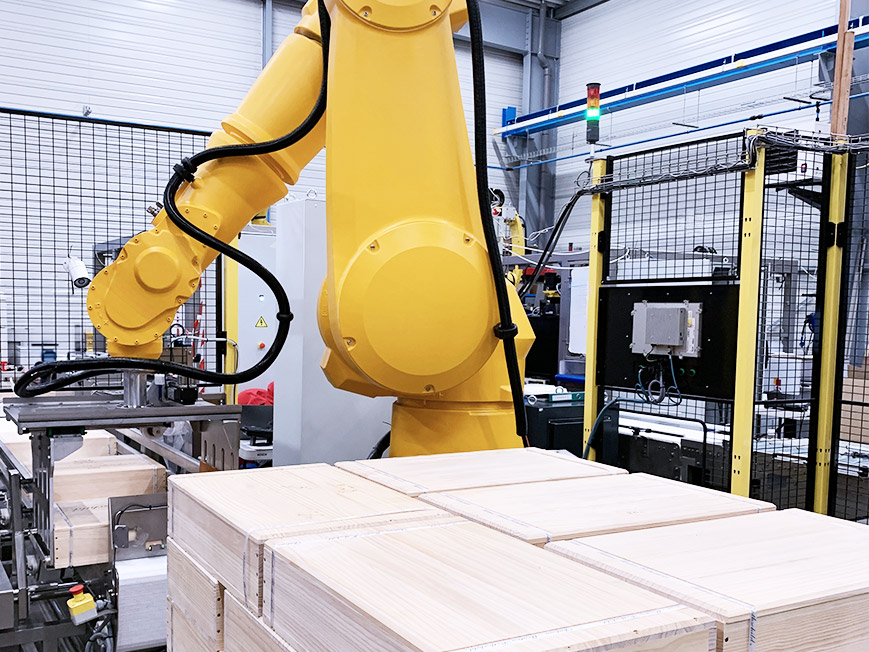
For palletising cartons, JYGA recommends the PAL’IT AIR cobot, the PAL’IT ONE compact palletiser or the robotic palletiser. The choice depends on the throughput, the case weight and the space available, based on the data above. A JYGA palletiser handles RSC cases, wrap-around cases and wooden cases.
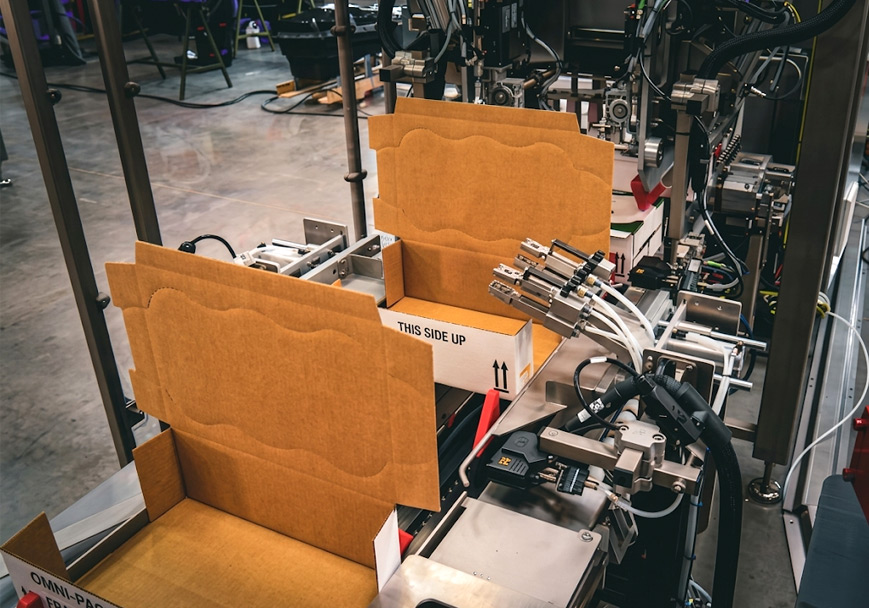
Upstream, packing into RSC cases can be carried out by a JYGA case packer, which can erect and fill the case. Three types of cases can be used:
- RSC cases
- closed wrap-around cases
- wooden cases
Palletising bags, jugs, multipacks or totes
The JYGA range also palletises bags, jugs, multipacks and, in logistics, collapsible plastic totes. For bags, JYGA selects a gripper suited to their flexible shape. The cell is then sized according to their weight and the target throughput.
Information to gather for your project
To study your project, the JYGA pre-sales team needs the following information:
- the products and their packaging: cases, bags, jugs, multipacks, totes;
- the dimensions and weight of each package;
- the throughput per line and the number of lines to be served;
- the pallet format and the required loading pattern;
- the space available, access points and traffic around the station;
- whether operators work nearby;
- the expected options and the site constraints.
This information forms the basis for costing your solution.
Palletising pattern
software
The JY’TOOL palletising pattern software, built into the palletiser’s operator terminal, is used to create palletising patterns for JYGA palletisers. The tool lets you design column-stacked or interlocked patterns, with or without layer pads.
Operators use it to create or modify a pattern when a new SKU comes in. The software is compatible with the PAL’IT ONE, the PAL’IT AIR and the single-line and multi-line palletisers.
Our gripping
solutions
- Clamp gripper
- Fork gripper
- Vacuum plate gripper
- Sliding curtain gripper
What our customers say

Agri-food
Cobot Palletizer for Open Trays
JYGA installed a Pal’it Air collaborative palletizer for open trays of goat cheese at a family-owned dairy. Empty pallets are placed by the operator at two floor positions. At the case-packing outfeed, labelled packs are stacked if required and then conveyed to the cobot. Using its dedicated gripper, Pal’it Air picks the packs and places them on the pallet according to the pattern defined in JY’TOOL software. The cobot alternates between the two stations, significantly reducing physical strain while producing consistent, stable pallets.
Our latest palletising
projects
Across our projects, JYGA palletising systems adapt to a wide range of environments: healthcare, logistics, food and beverage… Each project illustrates a custom integration of our industrial palletisers or cobots, designed to reduce manual handling, protect operators and make shipments more reliable. A practical way to measure the productivity gains and added value of automated palletising in your plants.
No content found.
Our method
01
Pre-sales
02
Order
03
Delivery and installation
04
Commissioning
05
Final acceptance
01– Pre-sales
Pre-sales
Everything starts with a clear, practical discussion: throughput targets, carton formats, packaging types, layout constraints, required safety level… JYGA advises you on the most suitable solution and builds a costed, reasoned proposal. You move forward with a precise view of the outcome, the target performance and the return on investment.
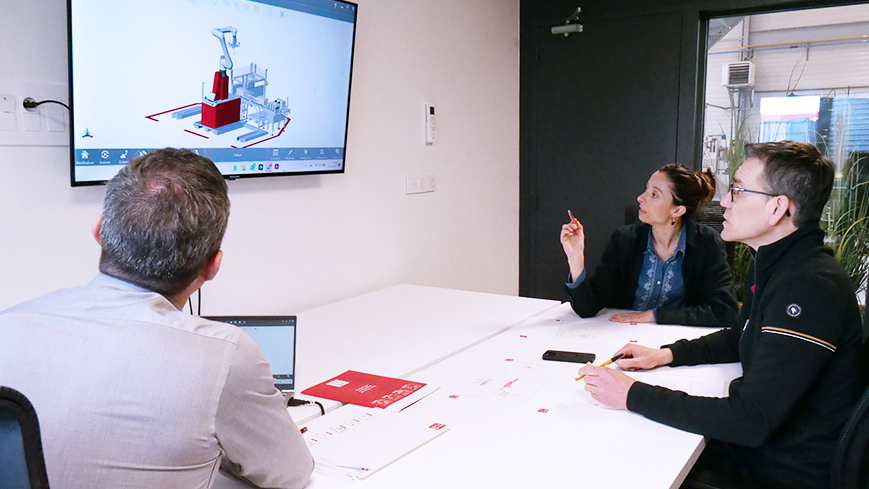
02– Order
Kick-off meeting at the customer’s site
The kick-off meeting frames the project from the outset: throughput targets, formats, cartons and packaging to be handled, layout constraints and performance expectations. JYGA agrees with you on the schedule, the interfaces with existing equipment and the key points to secure for a smooth roll-out and a compliant result.
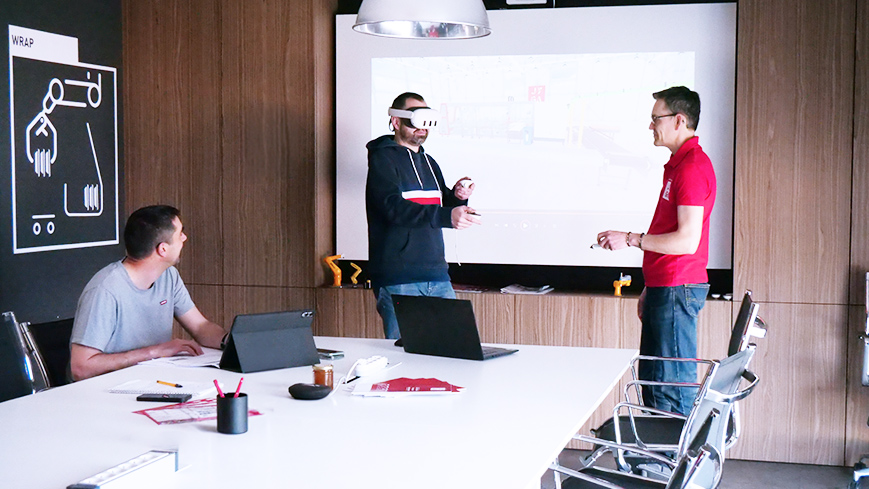
02– Order
Virtual reality layout review at JYGA
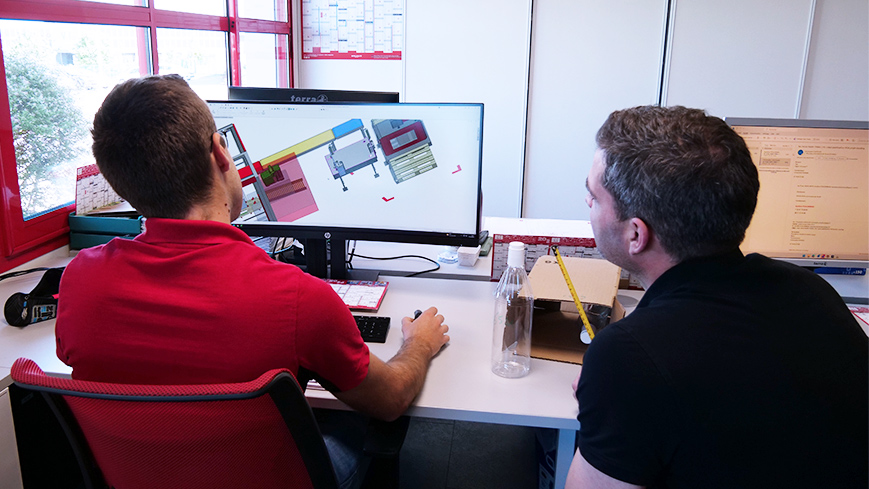
The virtual reality layout review is used to validate the layout before manufacturing and installation. Using a 3D model, you can see the whole installation: footprint, operator access, maintenance areas, interfaces with existing equipment and the flow of cartons and packaging. This step secures the integration and confirms that the solution meets your production and safety constraints.
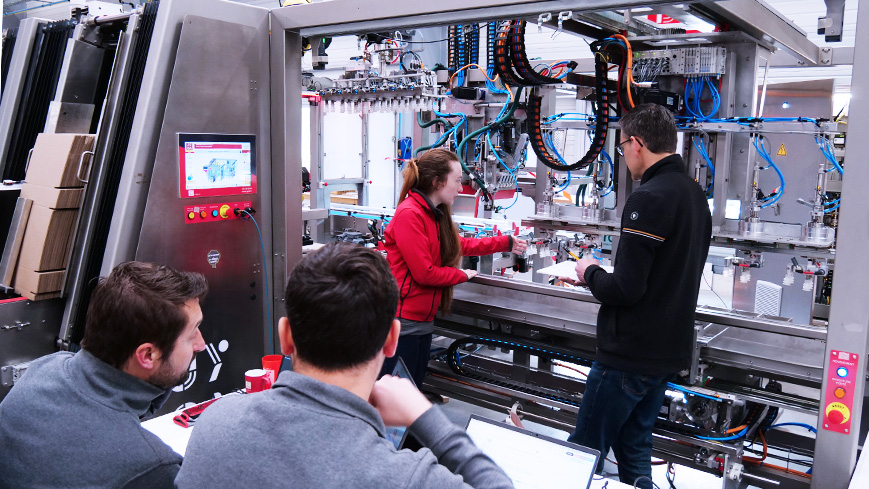
02– Order
Preliminary acceptance in the JYGA workshop
After the machine has been assembled and tested in its workshop, JYGA welcomes the customer for the preliminary acceptance, or FAT. The tests reproduce near-real operating conditions: product pick-up and integrity, format changeovers, throughput, compliance with the palletising pattern and pallet stability.
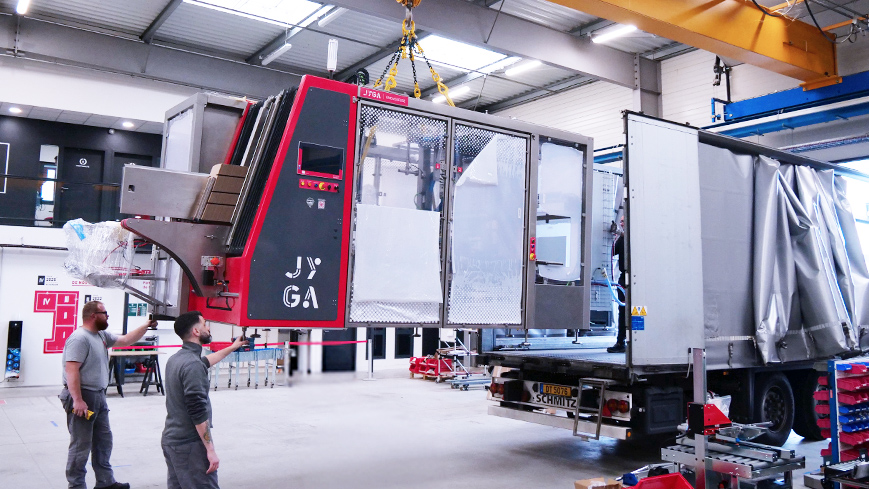
03– Delivery and installation
Delivery and installation
We handle delivery and on-site installation while respecting your production constraints. JYGA teams coordinate the set-up, connections and integration into your environment. Each step is planned to minimise downtime and deliver a smooth, seamless end-of-line solution.
04– Commissioning
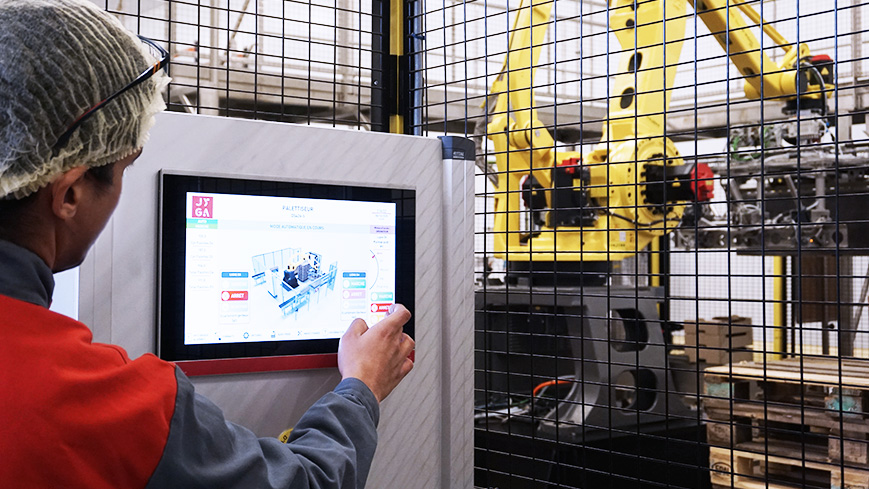
Site acceptance in your plant (SAT)
On site, we carry out the same tests again as during the FAT. Among other things, this step validates the throughput, compliance with the pattern and pallet stability under real production conditions.
04– Commissioning
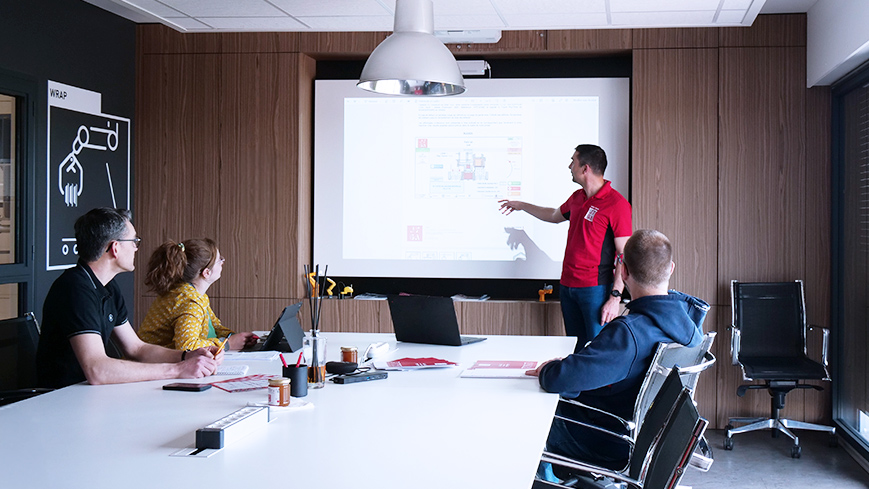
Staff training
JYGA trains your operators and technicians to run the installation independently. Settings, format changeovers, quality checks, good practice and first-level maintenance: everything is covered to keep the equipment stable and performing well. The aim is simple: preserve the quality of cartons and packaging, save time day to day and ensure reliable operation over the long term.
05– Final acceptance
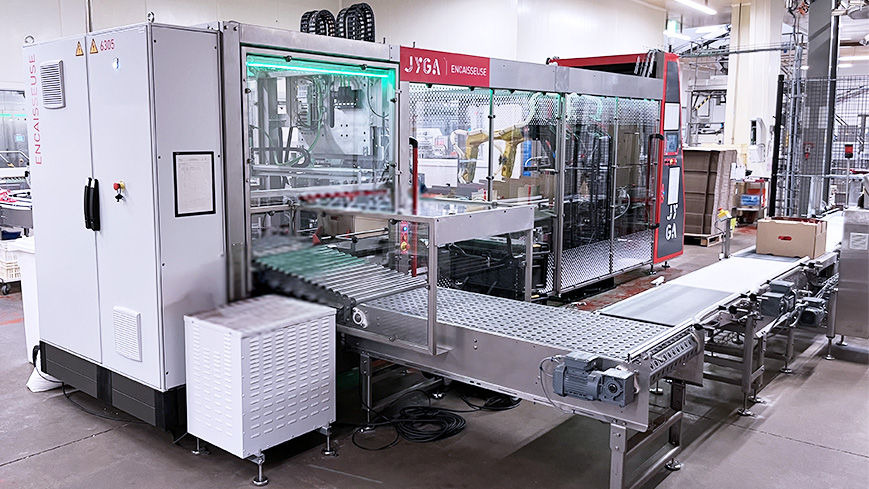
Final acceptance
Once the objectives have been met, final acceptance formally confirms that the installation is compliant. Performance, safety and operation are validated together. JYGA remains at your side after production starts, with long-term support and follow-up solutions to maintain the reliability of your installation and upgrade your equipment if your needs change.
We invite you to our showroom
Come and discover our showroom and talk to our specialists. On site, we present solutions suited to your packaging projects.
7 rue Edouard Branly, 49280 La Séguinière, France
Monday to Friday, 8 am to 5:30 pm
Preparing your palletising project
How much does an automatic palletiser cost, and what does the price depend on?
The price of an automatic palletiser depends on its configuration: machine type, throughput, number of lines, gripper, conveying and integration into the existing line. The cell options also affect the budget: empty pallet destacking, layer pads, labelling, stretch wrapping, hooding or top sheet placement. JYGA does not publish prices, because it designs each machine for a given product and end of line. The pre-sales team costs the solution based on your specifications. It first analyses your flows, your throughput and the space available. To obtain a quotation, send JYGA your products, the throughput of each line and the layout of your end of line.
How much space is needed to install an automatic palletiser?
The space required for an automatic palletiser depends on the type of machine. The JYGA robotic palletiser occupies 3,500 × 3,500 × 2,200 mm (JYGA 2026 brochure); this footprint applies to one line. The PAL'IT AIR cobot, which works without safety fencing, fits within 800 × 1,740 × 1,372 mm for one palletising station. The PAL'IT ONE compact palletiser occupies 2,310 × 3,545 mm in its single version. It can be moved without reconfiguration if the layout changes. Around the machine, also allow for the package infeed, empty and full pallets and maintenance access. JYGA studies the layout during the pre-sales phase, then presents it to you in virtual reality before manufacturing. The final cell dimensions are defined according to your project.
Can an automatic palletiser handle several formats and SKUs?
Yes, an automatic palletiser handles several formats: it switches SKU by recalling the corresponding palletising pattern. On the JYGA robotic palletiser, a format changeover takes less than 5 minutes (JYGA 2026 brochure). The patterns for each SKU are created with the JY'TOOL software. They are stored on the operator terminal, ready to be recalled. JYGA sizes the gripper for the range of formats set out in the specifications. A complete list of current and planned SKUs makes it possible to size the cell from the pre-sales stage. For the other machines in the range, the duration of a format changeover is defined according to the project.
Can a palletiser be added to an existing packaging line?
Yes, JYGA integrates palletisers into existing packaging lines and upgrades end-of-line installations already in place (retrofit). The pre-sales study starts from the existing installation: package outfeed, conveying, pallet flows and free space at the end of the line. The cell is then connected to the line via the package infeed conveyor. This connection also works with several upstream machines: in processed meat, a multi-line cell for blood sausage trays and shelf-ready (PAV) cases receives cases from two different case packers. Virtual reality validates the layout and the interfaces with existing equipment before any work on site. Installation is then organised to minimise production downtime. If the pre-sales study reveals other needs, JYGA can extend the project to the entire end of line, from case packing to palletising.
When is a fenceless palletising cobot sufficient?
A fenceless palletising cobot is sufficient when the throughput is moderate, the cases are light and operators work around the station. The JYGA PAL'IT AIR palletises 6 to 18 cases/min (JYGA 2026 brochure). It handles cases weighing up to 20 kg. It serves one or two lines simultaneously. A line palletising around fifteen cases per minute therefore falls within its range, provided each case weighs no more than 20 kg. The PAL'IT ONE compact palletiser takes over for cases from 20 to 25 kg, up to 16 cases/min. Above 18 cases/min, a JYGA robotic palletiser handles up to 35 cases/min; its load capacity is defined with the specifications. Even without fencing, the safety of the station is assessed together with the layout of the PAL'IT AIR palletising cobot.
How do you obtain stable pallets with an automatic palletiser?
Pallet stability is prepared at three levels: the palletising pattern, package pick-up and pallet finishing. The palletising pattern, prepared in JY'TOOL, sets the orientation of the packages and the interlocking of the layers. The pick-up mode, whether individual, by row or by full layer, is chosen according to the product. Between layers, layer pads reinforce load stability when the pattern includes them. Pallet collars can complete the pallet. At the cell outfeed, stretch wrapping, hooding, top sheet placement or strapping secure the pallet for transport. These options are chosen with the specifications. At JYGA, pallet stability is part of the tests in the workshop and then on site.
How do you estimate the profitability of an automatic palletiser?
The profitability of an automatic palletiser is calculated by comparing its total cost with the cost of manual palletising. The total cost includes the machine, its installation, staff training and maintenance. On the other side, quantify the handling time freed up, the target throughput and the number of lines served. A JYGA multi-line palletiser serves up to 4 lines. Reducing physical strain and musculoskeletal disorders also comes into the decision, even if it is harder to quantify. The costed, reasoned proposal provided by JYGA during the pre-sales phase specifies the target performance. It serves as the basis for the calculation for your site. JYGA does not publish a typical payback period, because it depends on each project.
What maintenance should be planned for a robotic palletiser?
Maintenance of a JYGA robotic palletiser is organised through the Performance Support Service, which follows the machine from start-up. The service combines assistance, training, remote maintenance, spare parts and on-site interventions. The service options are formalised in a Performance Support Contract. The preventive maintenance plan depends on the cell configuration and its use: robot, gripper, conveyors and options. During commissioning, JYGA trains your operators and technicians in first-level maintenance. In the event of an incident, remote maintenance allows an initial diagnosis, before any on-site intervention. The Performance Support Service also supports the upgrading of the equipment if your needs change.
Learn more about palletising
No content found.
Industrial palletising
Palletising groups packages on a pallet to form a stable load, ready to be stored, handled and transported. In a factory, it takes place at the end of the line, once the products have been packed into cases, bags or multipacks. The article How to palletise products efficiently explores the method in more detail.
What is an automatic palletiser?
An automatic palletiser is an end-of-line machine that stacks packages on a pallet without operator intervention. It places the packages layer by layer, following a palletising pattern specific to each SKU. At JYGA, this machine takes the form of a robotic or cobotic cell, designed around the product to be palletised.
Three levels of automation coexist. On a manual or semi-automatic palletiser, the operator places some or all of the packages. An automatic palletiser picks up and places all the packages on its own. Depending on the cell options, it also handles the infeed of empty pallets and the discharge of full pallets.
What does an industrial palletiser do?
An industrial palletiser handles the final operation of the packaging line. It receives the closed packages and builds pallets ready for shipping. It replaces manual stacking on pallets, a repetitive task that exposes operators to physical strain and musculoskeletal disorders (MSDs).
Automatic palletising also brings consistency. The machine reproduces the same pattern from one pallet to the next and keeps pace with the packaging line.
How does a palletising robot work?
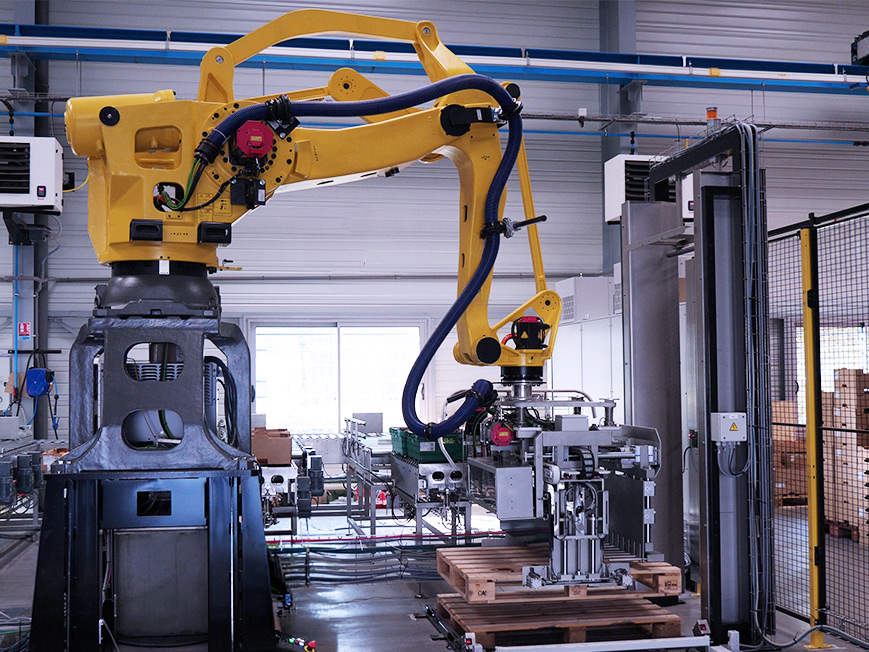
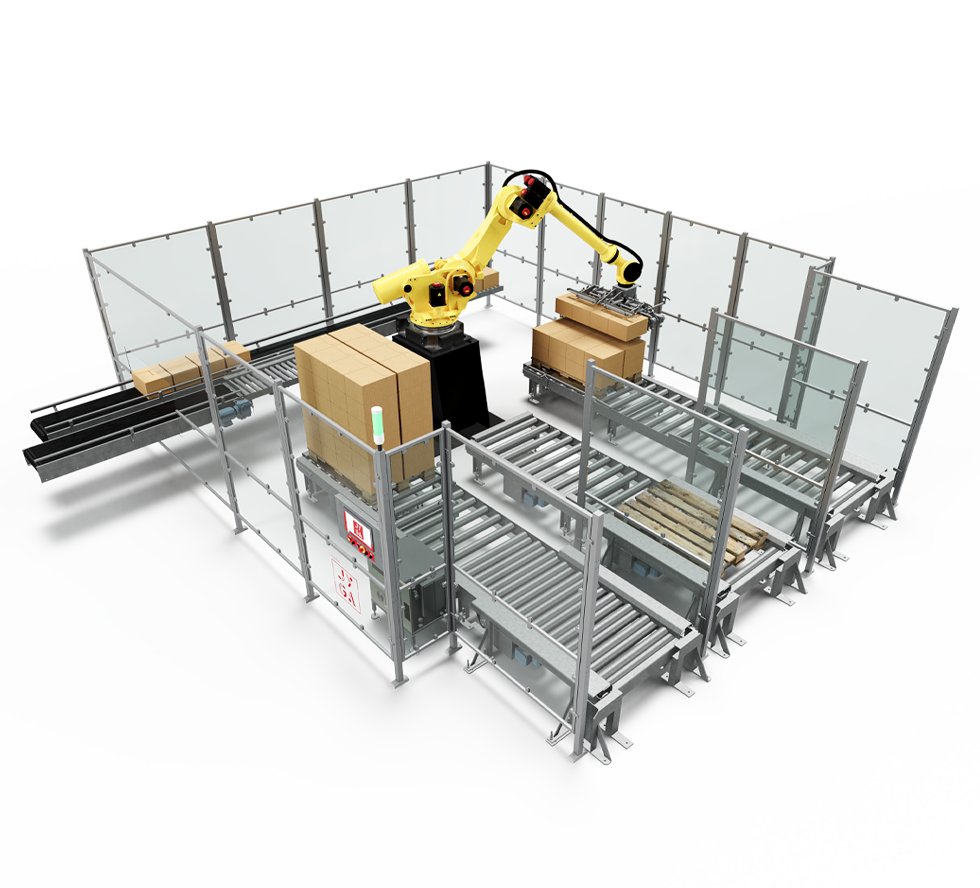
In robotic palletising, the robot works inside a palletising cell. This cell brings together the robot, its gripper, the package infeed conveyors and the safety equipment. A palletising robot follows a five-step cycle:
- Packages arrive from the line by conveyor at the pick-up area.
- The gripper picks them up individually, by row or as a full layer, depending on the product.
- The palletising robot places them on the pallet following the palletising pattern for that SKU.
- Between two layers, the cell inserts a layer pad if the pattern requires one.
- The full pallet leaves the cell and an empty pallet takes its place.
Depending on the project, the palletising cell also integrates empty pallet destacking, labelling, stretch wrapping, hooding or top sheet placement. It can handle one or more pallets simultaneously.
JYGA does not manufacture robots: its design office engineers the cell around an industrial robot or a cobot. Its workshop assembles it, then its teams commission it on your line.