What Is an Industrial Thermoformer?
Reading time : 5 min

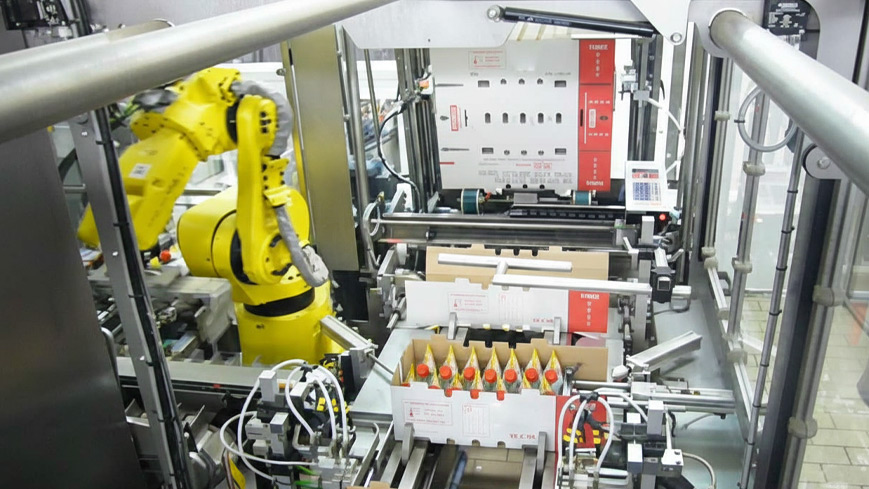
Flexible packaging is becoming increasingly common across many industries. In food and beverage as well as cosmetics, it is attractive for a number of reasons: lower material costs, compactness, easy shelf presentation and more.
Unlike rigid packs, flexible products can be difficult to handle automatically. However, technical solutions are available to automate case packing for flexible packaging across a wide range of sizes and weights.
Flexible packaging is particularly common in the food and beverage industry. The doypack, developed in the 1960s, is a typical example. This type of stand-up pouch can remain upright and makes product presentation easier. Flat-bottom plastic pouches are also widely used for grocery and confectionery products, while pillow and gusseted bags are common in snacking and dry-food applications.
Flexible packaging offers several advantages that explain its growing use. It can reduce raw-material consumption while still providing sufficient strength. It is practical for consumers, with formats that can be resealed or used as single portions. It is also attractive from a logistics perspective because it can reduce transport weight and volume.
Before automating the case packing of flexible packs, the characteristics of each product need to be understood. Conveying and handling pouches must be carefully designed to avoid damaging the product or compromising pack integrity.
The deformability of flexible packaging creates uncertainty in product position and geometry. A rigid carton has consistent dimensions, whereas the dimensions of a flexible pouch can change depending on how its contents are distributed. Automation therefore needs to be adapted to the behaviour of each product.
Our team is here to advise you.
Secondary packaging needs to be designed carefully so that automated case packing is reliable while also meeting customer requirements. In many applications, the case needs sufficient strength to compensate for the relative fragility of flexible packs and protect them during transport.
Several case types can address these requirements. The main families include:
Case dimensions should also be selected to optimise pallet utilisation and load stability.
Depending on the case packing principle — individual or multiple product pick — flexible packs need to be prepared and arranged so that they can be inserted reliably.
A wide range of solutions can be used:
Once the products have been grouped, case loading should follow immediately, either in one operation or in several successive loads.
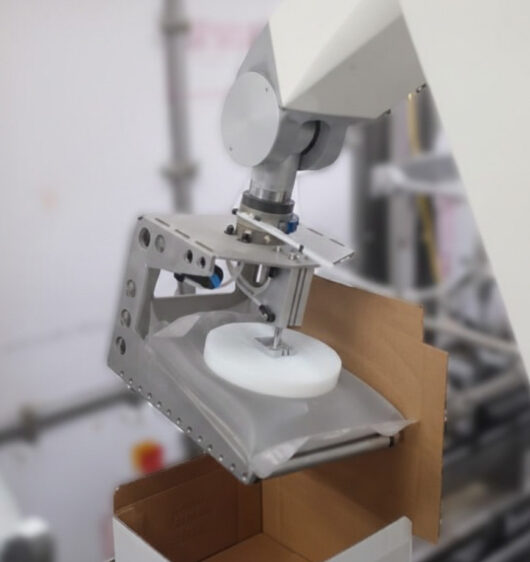
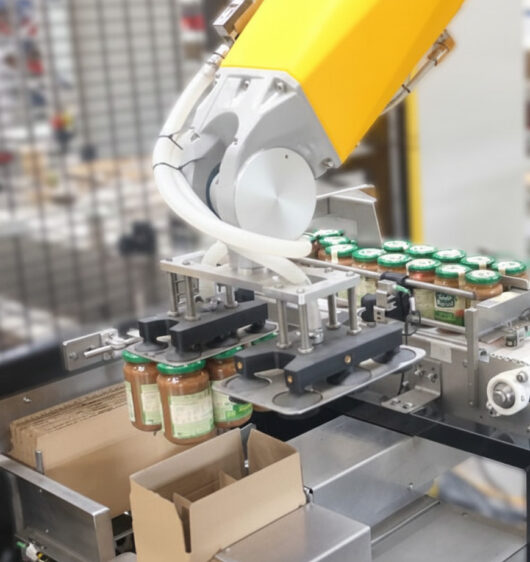
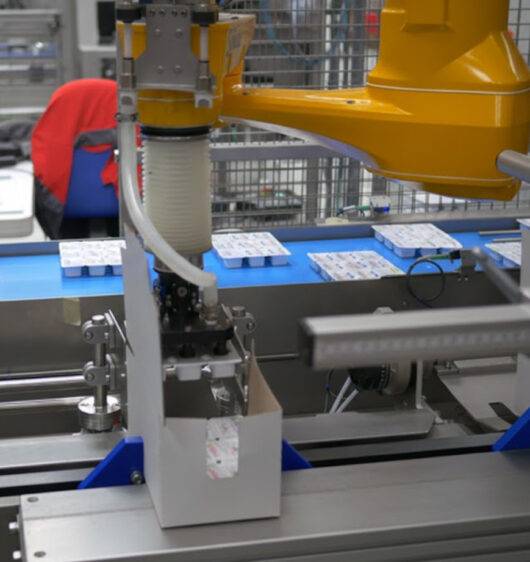
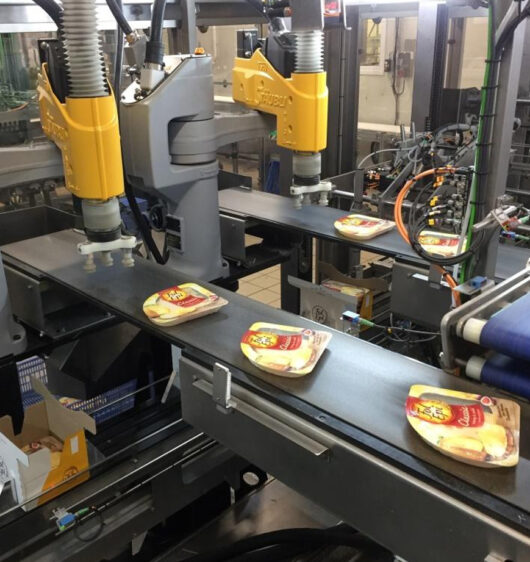
Several technical principles can be used for flexible packaging. Three common approaches are robotic wrap-around case packing, vertical drop loading and pick-and-place.
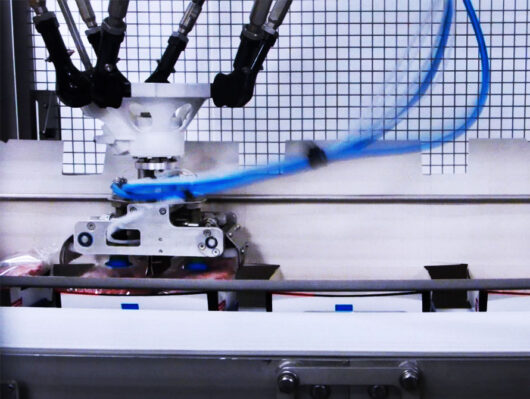
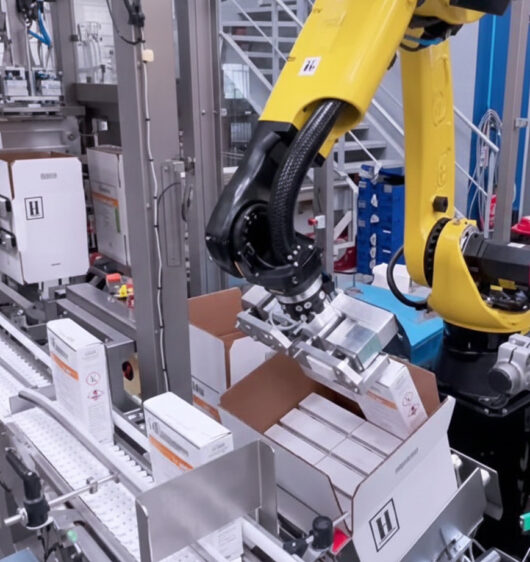
Well suited to highly flexible products, pick-and-place case packing provides accurate handling. The robot is fitted with an end-of-arm tool adapted to the product and, with the help of a vision system, can carry out different tasks:
Because the mechanical principle is relatively simple, pick-and-place can provide a flexible, scalable case packing solution while supporting high throughput.
This solution is mainly used for upright arrangements at high throughput. It is particularly effective for flat products such as trays. The principle is straightforward: the case is positioned under the conveyor, products are accumulated in the vertical chute in the required quantity, then tipped into the case.
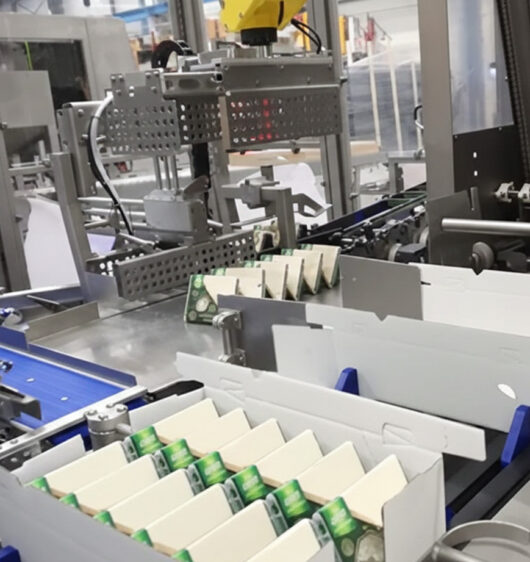
Pouches arrive flat on a conveyor. They are rotated through 90° using a suitable mechanism and accumulated on edge in batches. Each batch is then loaded into the case in one operation.
This principle can optimise case-loading speed.
Aurélie DUPONTCase Packing Division Manager

Would you like to know more? Find everything you need to know here, and much more!