What Is an Industrial Thermoformer?
Reading time : 5 min

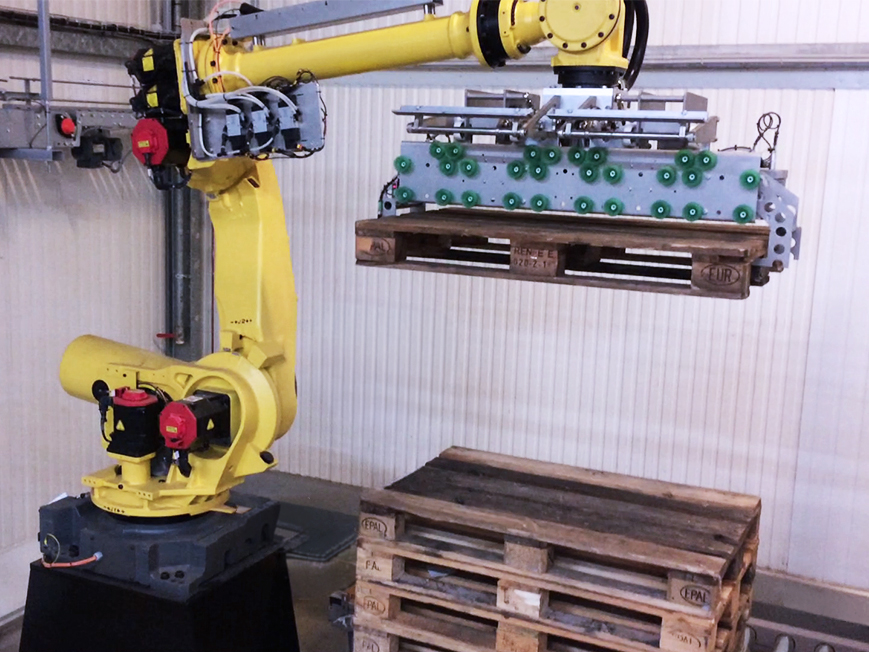
A pallet dispenser is a machine designed to separate empty pallets automatically from a stack. Its role is straightforward: take one pallet from the stack and place it at the required position to feed a production line, conveyor or palletising station.
At the end of a line, this operation can quickly become repetitive when performed manually. Operators may have to move heavy pallets, position them correctly and repeat the task for every cycle. On a continuously operating palletising line, irregular supply of empty pallets can cause stops, waiting time and unnecessary interventions.
A pallet dispenser helps make this stage more consistent. It can be installed close to an automatic palletiser, pallet conveyor or robotic cell. In some configurations, related equipment can also stack empty pallets after use.
This article explains the role of a pallet dispenser, how different systems work, their benefits and the criteria to analyse before integrating one into a production line.
A pallet dispenser removes one pallet from a stack of empty pallets and places it on a conveyor, at a palletising station or in a transfer area. It automates a handling operation that may appear simple but can become physically demanding when repeated throughout the day.
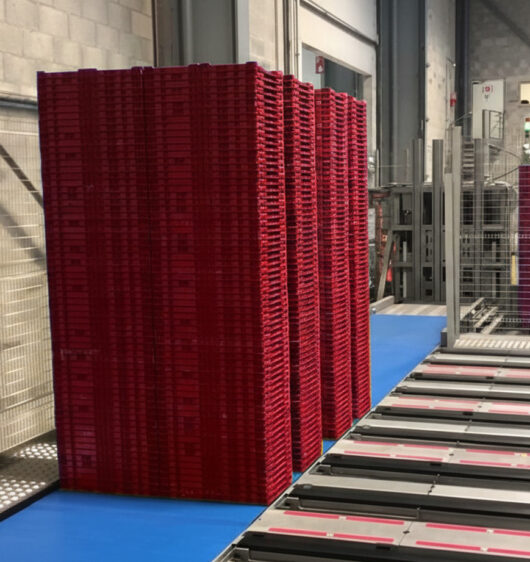
The machine generally works from a pallet magazine. Empty pallets are stacked in the magazine and then separated one at a time. Depending on the design, the system holds the stack, releases the bottom or top pallet, and transfers it towards the outfeed.
This function is particularly useful when pallets need to be supplied at a regular pace. On an automatic palletising line, for example, a pallet dispenser avoids interrupting the cycle while an operator manually places a new pallet at the loading station.
Our team is here to advise you.
A pallet dispenser separates stacked empty pallets and distributes them one at a time. A pallet stacker performs the opposite operation by grouping empty pallets into a stack for storage or collection. A depalletiser removes products from a loaded pallet.
This distinction is important because the terms are sometimes confused. A pallet dispenser handles the empty support. A depalletiser handles the products on the pallet. For example, an automatic depalletiser can remove cases, sacks or bundles from a pallet and feed them into a production line.
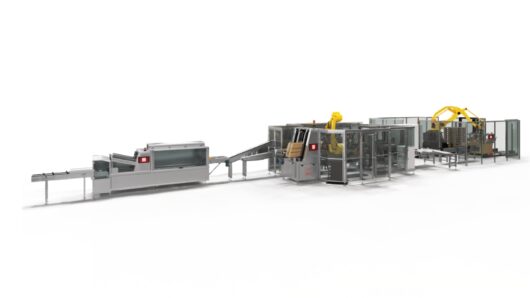
Several of these functions can coexist in the same installation: dispensing empty pallets, palletising products, conveying full pallets, stacking empty pallets or depalletising products according to the required flow.
The operating principle is simple: receive a stack of empty pallets, isolate one pallet and distribute it to the line. The mechanical design varies between systems but the basic function remains the same.
A pallet dispenser can use electric, pneumatic or combined mechanisms. Some units are designed as standalone equipment, while others are integrated directly into a pallet conveyor so that the line can be fed without manual transfer.
The machine can be adapted to pallet dimensions, material, condition and required throughput. A wooden Euro pallet, half-pallet, plastic pallet or custom support may require different handling arrangements.
On an automated line, the pallet can be dispensed directly onto a conveyor. Once separated from the stack, it is placed on the conveyor and transported to the next station, such as palletising, loading, buffer storage or inspection.
This keeps the flow regular. The operator no longer needs to carry every pallet to the correct position. A complete stack is loaded into the magazine and the machine then supplies pallets at the required rate.
This configuration is particularly useful on lines where the palletiser needs a continuous supply of empty pallets.
A pallet dispenser can be designed for wooden pallets, plastic pallets, Euro pallets, one-way pallets, half-pallets or custom supports. Selection depends mainly on dimensions, weight, rigidity and pallet condition.
Damaged pallets require particular attention. A broken board, protruding nail or distorted pallet can interfere with dispensing, block the machine or disrupt the line. Some pallet dispensers can therefore incorporate sensors or inspection systems to check pallet condition before distribution.
A pallet dispenser is most commonly installed at the end of the line, close to a palletising station or pallet conveyor. Its role is to feed the system automatically with empty pallets.
It can also be positioned upstream of a robotic cell, in a logistics area or on any line that requires a regular supply of supports. Integration depends on available space, pallet travel direction, operator access and required throughput.
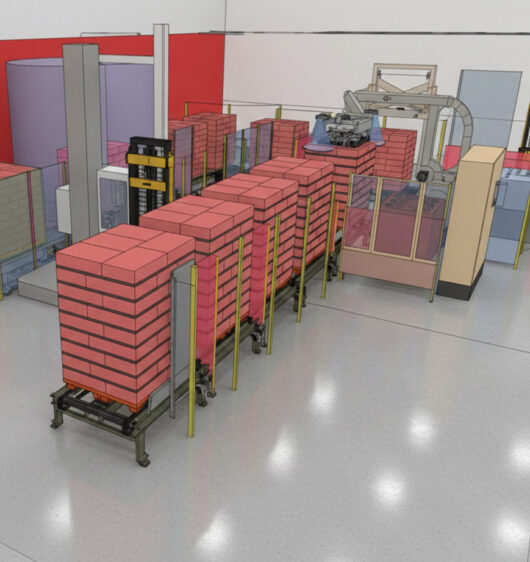
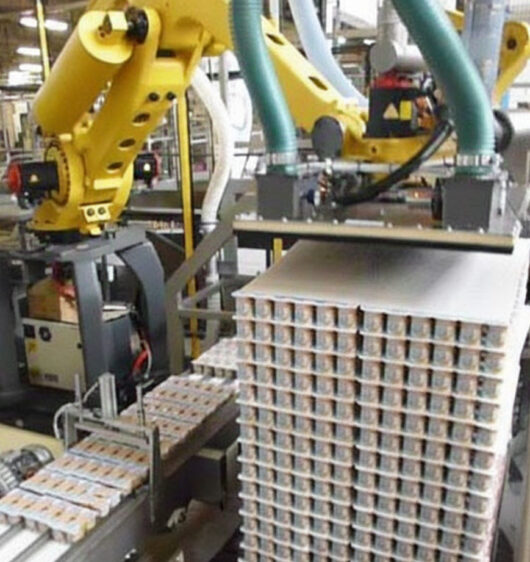
One of the most common applications is supplying empty pallets to a robotic palletiser. The pallet dispenser prepares the supports and sends them to the station where products are placed layer by layer, row by row or individually.
This avoids interrupting the palletising rhythm. In a robotic system, the robot can continue its cycle while empty pallets are delivered automatically to the correct position.
For more information on this stage, see Automatic palletising: why and how to get started.
A pallet dispenser also helps organise the working area. Empty pallets are grouped in a magazine rather than being spread around the line. The area becomes easier to manage, operator movements are reduced and flows are clearer.
This matters in workshops where several lines share the same palletising area. It reduces unnecessary crossings, manual transfers and delays caused by support replenishment.
The pallet dispenser can also operate with pallet storage equipment, conveyors, a robotic cell or forklift transfer depending on the selected layout.
The benefits of a pallet dispenser go beyond time savings. They include safety, production consistency, area organisation and more reliable pallet flows.
The first benefit concerns operators. Manual pallet separation involves repeated movements such as lifting, pulling, pushing, aligning and repositioning the support.
By automating this stage, the operator no longer needs to manage every pallet individually and can focus on loading the magazine, monitoring the line, format changeovers or station checks.
Reducing these repetitive movements can help limit fatigue and MSD risks, particularly on lines that palletise for many hours each day.
A pallet dispenser supplies pallets regularly. This avoids waiting between pallets and reduces manual intervention at the palletising station.
On a line where products arrive continuously, empty-pallet supply needs to keep pace. If a pallet is missing at the wrong time, the line can slow down or stop. A dispenser secures this stage by maintaining a stock of pallets in the magazine.
This continuity is particularly important in a robotic cell, where the robot should not have to wait for an operator to position a new empty pallet.
Poor empty-pallet supply can create micro-stoppages. Each may seem minor, but over a full production day their effect on line efficiency can become significant.
With a correctly sized pallet dispenser, pallets are prepared in advance and supplied at the required rate. Operators intervene less often, cycles are more consistent and downstream stations remain better supplied.
The principle is the same as for many other end-of-line automation functions: remove unnecessary interruptions, maintain clear flows and reduce handling that does not add value to the product.
Our team is here to advise you.
The right pallet dispenser depends on the line, the pallets and the required level of automation. A machine designed for a low-throughput line may not suit a heavily used robotic cell.
Before selecting equipment, observe the actual flow: how pallets arrive, who handles them, how many pallets are consumed per hour, where storage areas are located and which equipment needs to be fed.
Several criteria should be reviewed before integrating a pallet dispenser:
This assessment helps avoid choosing an overly standard machine for a non-standard flow. It also makes it possible to specify the right options from the start, such as conveyors, pallet storage, guarding, interfaces, presence checks or anomaly detection.
Pallet condition checks can be useful when pallets are reused, damaged, inconsistent or subject to strict quality requirements. A defective pallet can block the machine, interfere with palletising or create problems during transport.
Checks can cover pallet presence and position, broken boards, protruding nails or visible deformation. Depending on the required level, simple sensors or more advanced inspection systems can be used.
This is not always necessary. On a line using new, standardised pallets, inspection may be limited. On a line that reuses large numbers of pallets, it can become much more valuable.
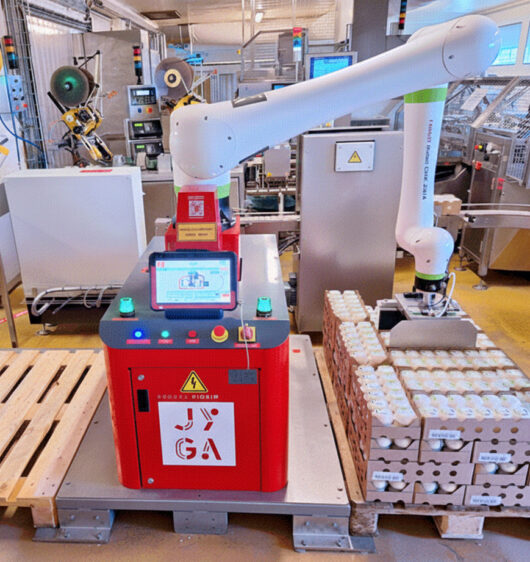
At JYGA, pallet dispensing can be integrated into a broader automatic palletising project. The objective is not simply to provide an empty pallet but to organise the complete flow: incoming products, pallet loading, support management, optional layer pads, full-pallet discharge and operator access.
In one JYGA biscuit-production application, stacks of empty pallets are loaded manually into a magazine accessible to the robot. The robot then takes pallets to each palletising station while cases arrive from the case packer on a conveyor line. The installation can operate with two powered palletising stations.
This example shows why pallet management should be considered from the cell-design stage. A well-designed pallet supply reduces stops, limits operator movements and allows the robot to work with a more consistent flow.
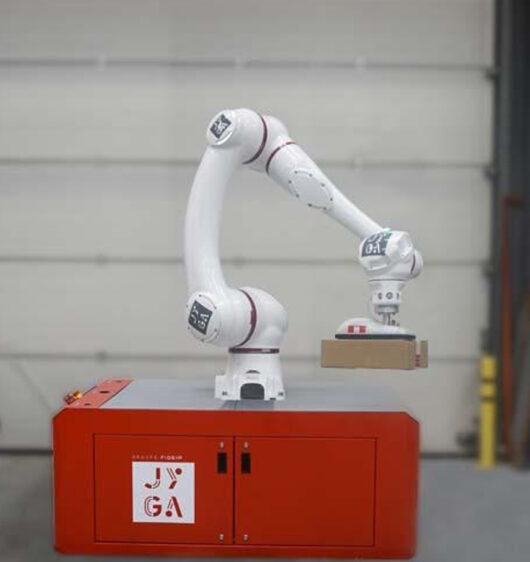
JYGA designs robotic palletising solutions that can include associated modules such as pallet magazines, pallet storage, conveyors, layer-pad handling and other peripheral equipment. On some compact cells, a pallet magazine can be included as one of the configurable functional modules.
See also this case study: Case depalletiser / pallet dispenser.
A pallet dispenser automates a simple but repetitive operation: separating stacked empty pallets and supplying them to a line, conveyor or palletising station. At the end of a line, it helps reduce manual handling, organise the area and maintain a regular flow.
Selection depends on pallet type, throughput, layout, loading method and required automation level. On lines equipped with a robotic palletiser, a pallet dispenser can become an important part of the flow because it avoids waiting for empty pallets.
Would you like to automate empty-pallet supply or integrate a pallet dispenser into a palletising cell? JYGA can assess your needs, pallets, layout and the equipment compatible with your end-of-line system.
Aurélie DUPONTCase Packing Division Manager

Would you like to know more? Find everything you need to know here, and much more!