What Is an Industrial Thermoformer?
Reading time : 5 min

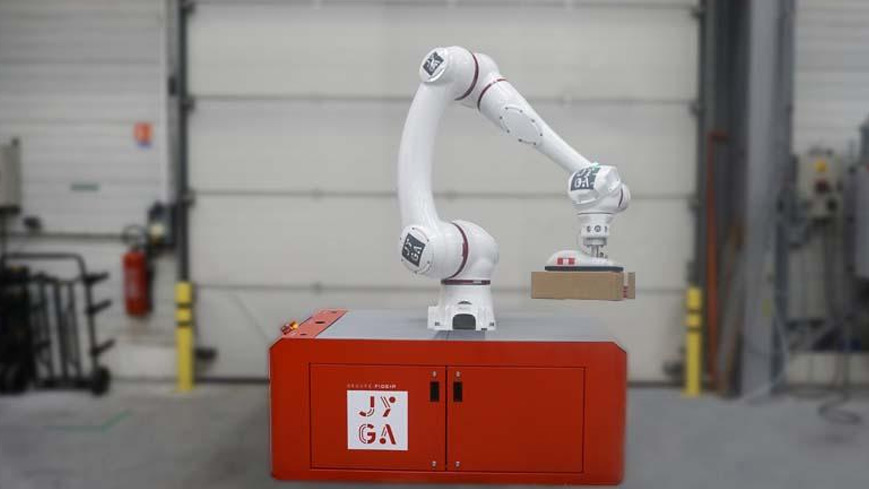
On some packaging lines, manual palletising quickly becomes difficult to sustain. Cases accumulate, operators repeat the same movements, pallets need to be prepared at the right pace and the available space does not always allow a fixed cell to be installed.
A mobile palletiser addresses this type of situation. It automates palletising while retaining a degree of installation flexibility. Depending on the configuration, it can be moved, reassigned to another line or integrated into a production area where a larger fixed installation would be difficult to accommodate.
The aim is not to replace every fixed palletising system. A mobile palletiser is more suited to specific requirements: limited space, low or medium throughput, existing lines, format changes or the need to reduce manual handling without redesigning the complete end of the line.
To compare the different automatic palletising solutions, see the JYGA palletiser range. This article focuses specifically on the mobile palletiser.
A mobile palletiser is a palletising cell designed to be easier to install, move or reassign than a conventional fixed system. It takes products from the line outfeed and places them on a pallet according to a defined pallet pattern.
It can be used to palletise cartons, cases, bundles, trays and other packaged products, provided that the end-of-arm tool is suitable for the format being handled.
The meaning of “mobile” can vary between configurations. In some cases, the cell can genuinely be moved from one line to another. In others, it is primarily compact, easier to integrate into a restricted area or designed to operate close to operators. This is why it is important to distinguish between a mobile palletiser, a compact palletiser and a collaborative palletiser.
A fixed palletiser is generally designed to remain on a specific line. It may include several pieces of peripheral equipment around the robot, such as conveyors, pallet magazines, layer-pad handling, automatic full-pallet discharge, guarding and interfaces with other machines.
A mobile palletiser follows a different approach. It should adapt more easily to an existing configuration or to a line that changes over time. It is often selected when a factory does not want to make major layout changes, or when several palletising stations are not operating at the same time.
The right choice therefore depends on the actual requirement. A high-throughput, stable and highly structured line may justify a fixed cell, while a lower-throughput line with less space or changing formats may be better suited to a mobile or compact solution.
A compact palletiser focuses primarily on a reduced footprint. It is designed to occupy less floor space and integrate into already congested production areas.
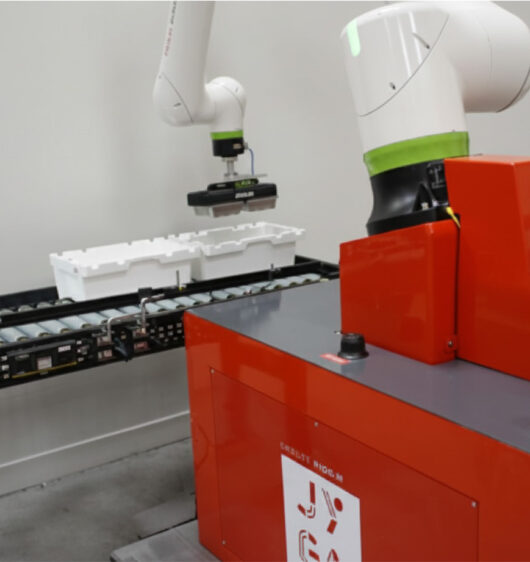
A collaborative palletiser is designed to operate close to operators using an application-specific safety approach. It can be useful where teams need to continue moving or working around the station.
A mobile palletiser can be compact, collaborative or both, but these terms are not interchangeable. The key question is whether the priority is to save space, move the cell, work close to operators or combine several of these requirements.
The PAL’IT Air collaborative palletiser, for example, is designed for collaborative end-of-line palletising applications. A solution such as the PAL’IT compact palletiser focuses more on a compact cell with configurable functions depending on the application.
Our team is here to advise you.
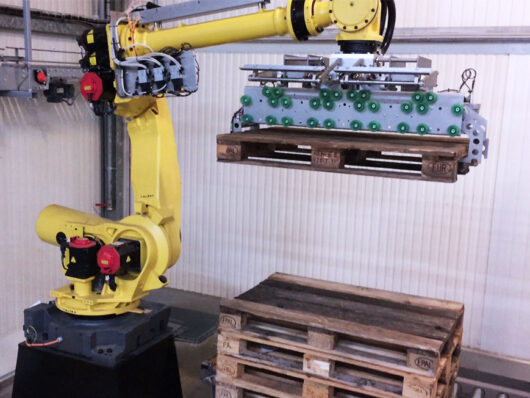
A mobile palletiser works on the same basic principle as an automated palletising cell. Products arrive at the end of the line, generally on a conveyor. The robot picks them using an end-of-arm tool and places them on a pallet according to the selected pattern.
The cell can include an infeed conveyor, pallet area, operator interface, safety devices and palletising recipes. Depending on the level of automation, empty-pallet supply and full-pallet discharge can remain manual or be partly automated.
Ease of use is important. A mobile palletiser is often selected for integration into an existing workshop, so operators need to understand it easily, maintenance teams need good access and the cell needs enough flexibility to follow production changes.
The robot performs the pick-and-place motion. It needs to reach the incoming product area, the pallet and sometimes several positions if the cell handles different formats.
The end-of-arm tool grips the product. It may use vacuum cups, a clamp, mechanical gripping or a custom design. The choice depends on the product, whether it is a closed carton, open case, bundle, tray, sack or another format.
A rigid, regular case is easier to handle than a flexible, slippery or fragile product. The actual product should therefore be assessed at the beginning of the project. Weight, material, stability and gripping surface directly influence cell design.
The palletising pattern defines how products are arranged on the pallet: products per layer, orientation, optional interlocking, final height and overall stability.
On a line handling several SKUs, managing pallet patterns becomes important. Operators should be able to change format without excessive downtime and retrieve or adjust existing recipes when required.
The JY’TOOL software can be used to create, modify and save palletising patterns from a dedicated interface. This type of tool simplifies cell operation when formats change regularly.
A mobile palletiser is particularly relevant when a company wants to automate a station without installing a more structurally fixed cell. It suits production areas that need flexibility but still want to reduce manual palletising.
It can also suit sites that want to automate progressively. A company can automate a first station, measure the benefits and then adapt its organisation based on operational feedback.
Limited space is one of the most common reasons for considering a mobile or compact system. A fixed cell may require additional conveyors, a pallet area, guarding, maintenance access and sometimes a wider line reorganisation.
A compact or mobile palletiser can reduce some of these constraints. It does not remove safety requirements or the need for operator access, but it can reduce the space required around the station.
The layout still needs careful study, including product arrival, pallet position, full-pallet discharge, operator circulation and maintenance interventions.
A mobile palletiser is often suited to low and medium throughput. It takes over repetitive handling without imposing a large amount of additional infrastructure around the line.
At very high throughput, a more structured fixed cell may be more appropriate. It can integrate additional peripheral equipment such as automatic pallet supply, layer pads, complete conveying, full-pallet discharge and outfeed inspection.
Throughput should not be considered in isolation. Flow consistency also matters. A moderately paced but stable line has different requirements from a line with significant production peaks.
A mobile palletiser can be useful on existing lines, especially where the production area was not originally designed to accommodate a fixed robotic cell.
It can also be useful on multi-product lines. In this case, mobility alone is not enough. The cell must be able to handle different dimensions, weights, pallet patterns and pallet heights.
The gripping system and palletising recipes need to be designed for this variety. Otherwise, the cell may be mobile in theory but too limited for day-to-day production.
A mobile palletiser is not a universal solution. The equipment must remain compatible with the actual flow, products, throughput, safety rules and operational constraints.
Mobility also needs to be understood practically. Moving a cell may involve electrical supply, compressed air where required, conveyor connections, safety zones, pallet positions and production settings.
Before selecting a mobile solution, product weight, required throughput and load stability need to be known. A robot may have a defined payload, but actual cycle speed also depends on trajectories, gripping method and pallet height.
A heavy, unstable or difficult-to-grip product will require additional precautions. The cell may need to operate more slowly, use a specialist end-of-arm tool or use a pallet pattern adapted to the product.
Correct sizing must therefore be based on real production conditions, not simply a product datasheet.
A palletiser described as mobile should remain straightforward to reposition under real factory conditions. If each move requires lengthy adjustments, some of the practical value of mobility is lost.
Safety also needs to be considered. Even with a collaborative solution, a risk assessment is required. The robot, end-of-arm tool, handled product, speed, work area and operator behaviour all need to be taken into account.
Safety depends on the complete installation, not just the robot.
Palletising involves more than the robot. Empty pallets, layer pads, infeed conveyors, full-pallet discharge, operator access and maintenance all need to be considered.
The more peripheral functions that are added, the more space the cell occupies and the more structurally integrated it becomes. In some cases, a fixed solution may then be more appropriate than a mobile cell.
This should be decided early in the project: is the goal only to automate the palletising movement, or to automate the complete pallet flow around the station?
At JYGA, a mobile, compact or collaborative palletising project begins by analysing the product, flow and available space. The objective is not simply to install a robot but to design a cell that production teams can use effectively every day.
On an existing line, constraints can include occupied buildings, conveyors already in place, operator access, limited space, variable formats and full pallets that need to be removed. A collaborative or compact solution can make it possible to automate palletising without reorganising the complete workshop.
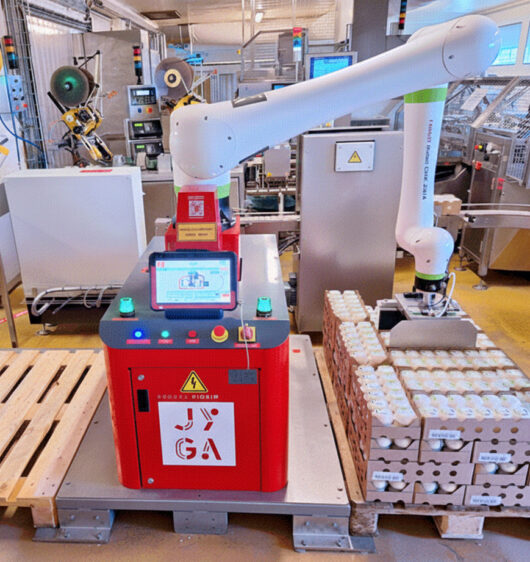
JYGA has, for example, integrated a cobot for palletising wine cases into an existing environment. This type of project shows the value of designing around real site constraints: products, available space, operator use and production continuity.
For a wider view of possible applications, our robotic palletising case studies cover cases, cartons, trays, food products, personal-care products and other packaged formats.
A mobile palletiser can automate pallet loading where a fixed cell is not always the simplest answer: limited space, existing lines, low or medium throughput, variable formats or the need to reassign the cell between production runs.
It helps reduce manual palletising, repetitive movements and end-of-line handling. Its suitability nevertheless depends on the product, throughput, pallet pattern, available space and safety requirements.
Before choosing, analyse the actual requirement: does the cell need to move regularly, simply be compact, operate collaboratively, or form part of a broader palletising project?
Would you like to assess a mobile, compact or collaborative solution for your line? JYGA can analyse your products, throughput and layout to define an appropriate end-of-line solution.
Aurélie DUPONTCase Packing Division Manager
Would you like to know more? Find everything you need to know here, and much more!